
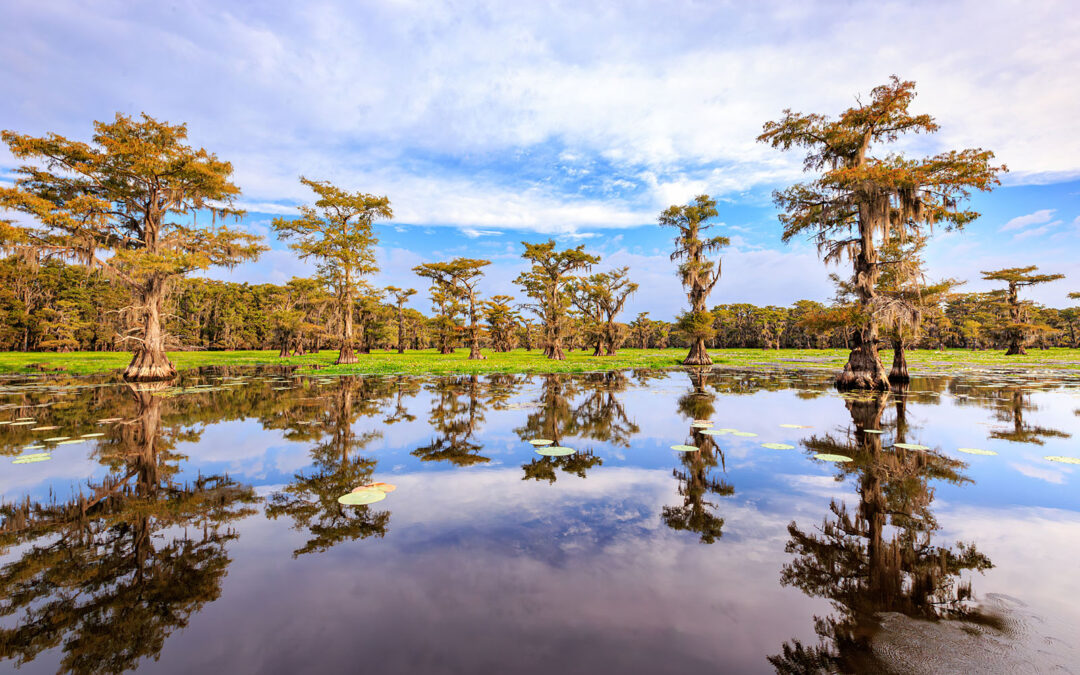
Forests cover much of the American South, but the region does not have an abundance of national forests. However, Caddo Lake in northeastern Texas boasts impressive bald cypress forests in its shallow, mysterious waters and is recognized as a wetland of international importance under the Ramsar Convention on Wetlands. The Caddo Lake Ramsar site encompasses 20,000 acres, including a state park and a state wildlife area.
Collaborations between the U.S. Fish and Wildlife Service, the Texas Parks and Wildlife Department, the U.S. Army, and the Caddo Lake Institute led to the Ramsar designation. Eagles lead vocalist Don Henley grew up in the nearby town of Linden and spent much of his childhood at Caddo Lake. In 1993 he co-founded the Caddo Lake Institute, which has spearheaded efforts to protect the lake’s ecosystem, including its listing as the 13th Ramsar site in the U.S. The designation is based on multiple criteria.
Contains a Unique or rare example of a natural wetland
Caddo Lake wetlands contain one of the best examples of a mature flooded bald cypress forest in the U.S.
Supports important populations of plant and animal species
Approximately 216 bird, 47 mammal, and 90 reptile and amphibian species occur in the area, many of which depend on the specialized habitat provided by Caddo Lake. Snowy egrets, great blue herons, and bald eagles are among the bird species that inhabit the ecosystem. A number of the lake’s animals and plants are considered rare, threatened or endangered. These species include peregrine falcon, alligator snapping turtle, and eastern big-eared bat. The Caddo Lake ecosystem is perhaps the most diverse community of plants in Texas. In addition to bald cypress trees draped with Spanish moss, iconic plant species include the American lotus and the American white waterlilly.
Supports animal species at critical life-cycle stages
The wetlands of Caddo Lake are crucial to migratory bird species within the Central Flyway. The area also supports one of the highest breeding populations of wood ducks, prothonotary warblers, and other birds.
Supports indigenous fish that contribute to global biological diversity
Caddo Lake supports as many as 86 fish species, including 18 species of game fish, which are important to the lake’s sports fishery, and the Caddo Lake Institute is working to reintroduce paddlefish, a native species.
But like other unique ecosystems, Caddo Lake faces threats from invasive species, the most serious from giant salvinia, a prolific water fern native to Brazil.
Photo: Spanish moss hangs from the branches of bald cypress trees, so called because they shed their needles in autumn, and water hyacinths cover the surface of a Caddo Lake swamp.