Judge Michael McShane, chief judge for the U.S. District Court of Oregon, struck down a 34-year-old environmental-law exemption used for wildfire logging. As reported by Alex Baumhardt for the Oregon Capital Chronicle, McShane’s ruling reversed recent Forest Service approvals for three commercial wildfire-logging projects in the Fremont-Winema National Forest in southern Oregon.
The decision is the result of a 2022 lawsuit brought against the U.S. Forest Service by regional conservation groups Oregon Wild, WildEarth Guardians, and GO Alliance. The lawsuit challenged the use of categorical exclusions that the Forest Service employs to avoid the scientific scrutiny and public input required by the National Environmental Policy Act of 1969 (NEPA).
To date, Congress has approved 25 categorical exclusions that can be invoked to circumvent NEPA reviews. The 2022 lawsuit specifically challenged the use of Categorical Exclusion 6 (CE-6). Since 1992, CE-6 has allowed the Forest Service to bypass NEPA-mandated environmental reviews if the logging is intended to “improve forest stand conditions” or wildlife habitat, or to prevent wildfires without “significant effect” on the human environment.
The CE-6 NEPA exemption was established on the heels of federal court rulings that forced the Forest Service to halt the vast majority of old-growth clear-cut logging on national forests because logging practices that benefited private industry were driving plant and wildlife species to extinction. According to Dr. Timothy Ingalsbee, the timing is no coincidence.
“The big shift in forest management and fire management came right at the early 1990s,” and right at that time, Ingalsbee says, “they were clear-cutting old growth to the point of driving species extinct. So there were court-ordered legal restrictions of clear-cut logging, and just like that, the focus of the agencies kind of morphed. They charted out prescriptions that basically any tree made of wood was subject to being salvage logged or thinned as hazardous fuel.”
The lawsuit was filed in response to Forest Service approval of three large “forest-restoration” and “wildfire-prevention” projects that would have allowed logging roughly 30,000 acres of national forest land without any environmental review.
McShane’s ruling states, “Because the record before the Court does not show the Forest Service considered the impact of thinning at any scale, commercial or otherwise, the Court cannot conclude the Forest Service engaged in a ‘reasoned decision’ regarding environmental impacts of the actions authorized by CE-6.”
CE-6 is limited by two provisions and little else: logging activities requiring building more than 1 mile of new road and herbicide use. In the early 2000s, only a decade after the CE-6 exemption took effect, the Government Accountability Office found that CE-6 was being used “frequently” to approve commercial logging projects on public lands while bypassing NEPA-mandated reviews.
“The Forest Service’s defense of CE-6 was a house of cards,” said Oliver Stiefel, attorney with Crag Law Center. “There is — and never has been — any legal basis for the agency to use a regulation intended for small, innocuous projects for massive commercial logging projects instead. We’re pleased to see the Court put an end to the agency’s overreach.”
John Persell, staff attorney for plaintiff Oregon Wild, said the Forest Service “will no longer be able to use this bureaucratic loophole to hide the impacts of massive commercial logging projects or exclude the public from having a voice on how our public lands are managed.”
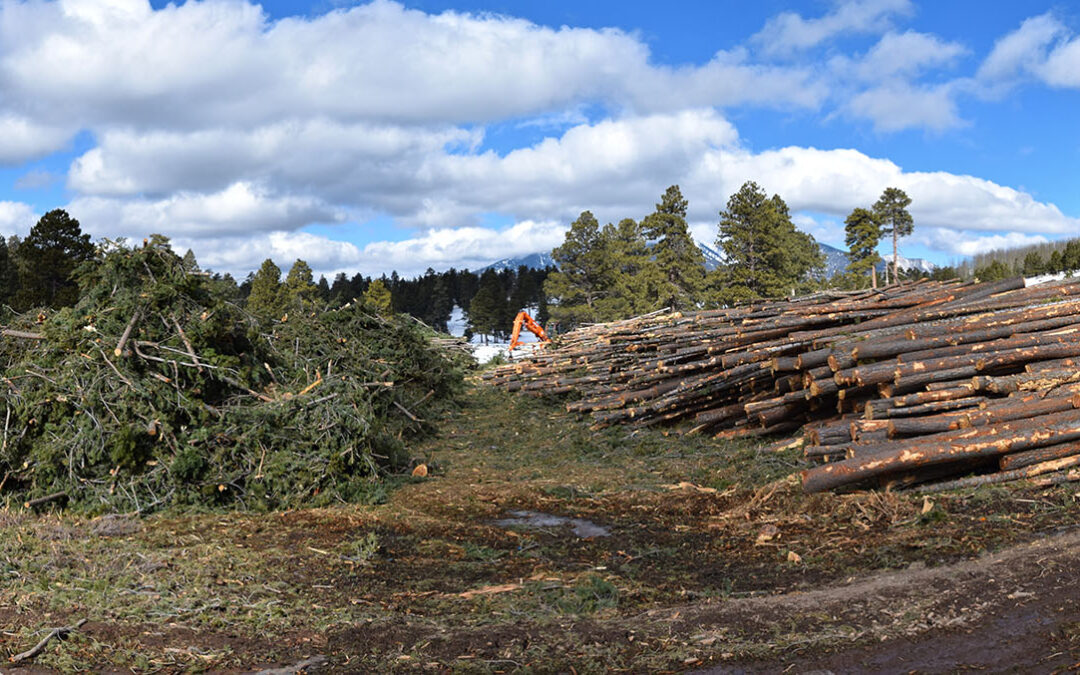
Photo: A 2019 “fuel-treatment” project used helicopters to perform 500 acres of wildfire logging in a remote section on the Coconino National Forest, Arizona (photo by Brady Smith, Coconino National Forest).