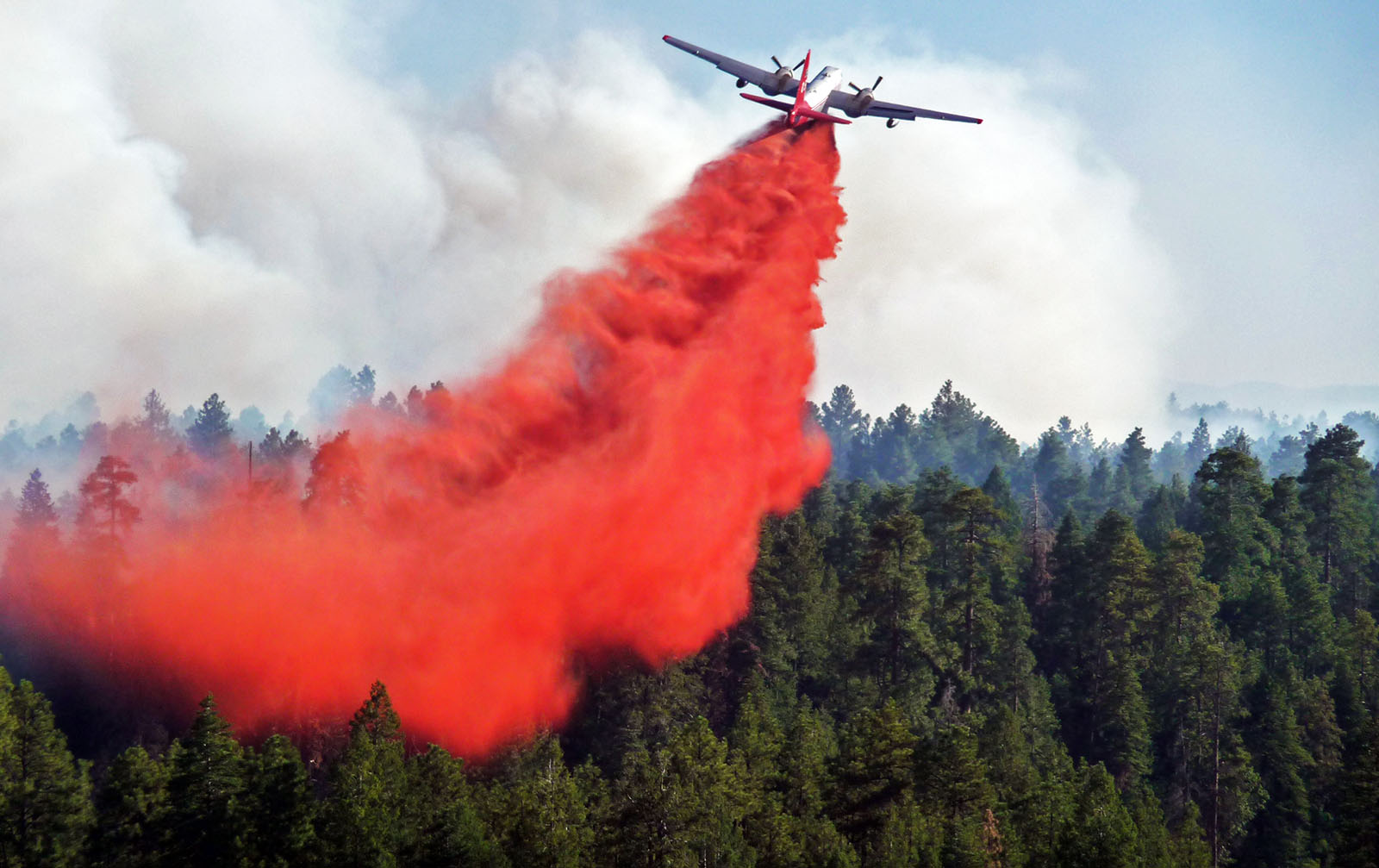
During New Mexico’s largest-ever wildfire — the 2022 Hermits Peak/Calf Canyon Fire, slurry bombers made nearly 2,500 retardant drops, primarily Phos-Chek, to combat the blaze. Phos-Chek is the bright red fire retardant featured on news reels to convey a visually dramatic example of agencies “doing something” to protect communities from wildfire. As FSEEE’s lawsuits demonstrate, we oppose aerial fire retardant as not only ineffective, but also as detrimental to the health and resiliency of our forests and watersheds. Data collected from wells near the fire prompted New Mexico to adopt a similar stance.
Cathy Cook with the Albuquerque Journal reports that an independent study found heavy metals in private wells near retardant drop zones. Hired by Mora County to check post-fire water quality in 2023, Zeigler Geologic Consulting documented an abrupt increase in heavy-metal groundwater contamination in 2025. Based on a 2024 study conducted by scientists at the University of Southern California’s (USC’s) Department of Civil and Environmental Engineering, the Ziegler report states, “The sudden appearance of high levels of antimony and manganese in these wells and surface water sites in 2025 suggests a connection to the use of fire suppressant materials.” Increases in antimony and manganese “were unexpected for the area’s geology,” according to Ziegler’s October 2025 report.
Four of the toxic metals detected in wells in the vicinity of the burned area — antimony, arsenic, cadmium and uranium — exceeded federal safe drinking-water limits. Ziegler also documented elevated levels of manganese, barium, chromium, copper, lead, thallium, and vanadium. The discovery of toxic metals in Mora County prompted the New Mexico Environment Department to offer free private well testing within one mile of the Hermits Peak/Calf Canyon Fire, including includes parts of Mora, San Miguel, and Taos counties.
Daniel McCurry, one of the USC study’s authors, said, “I think it’s very, very plausible” that the spike in heavy-metal contamination is connected to the use of aerial fire retardant.
Photo: A slurry bomber drops aerial fire retardant during the Taylor Fire on the Coconino National Forest, Arizona (Forest Service photo by Mike Chaveas).