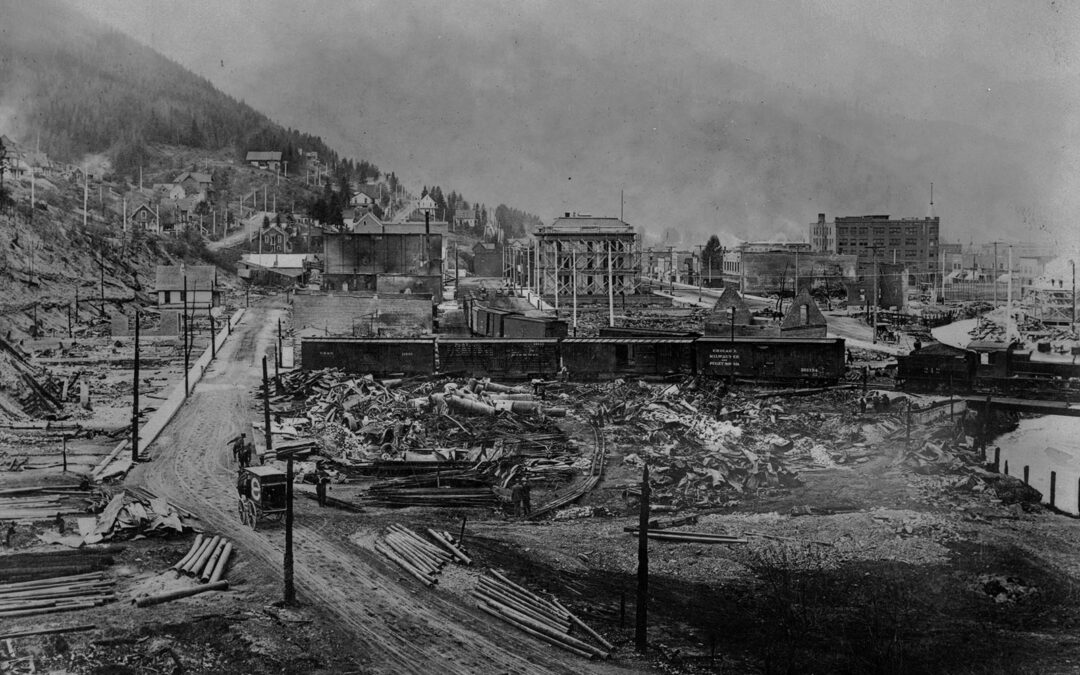
Following a fire season that started in April and grew worse during a summer of drought conditions, hurricane-force winds battered Idaho, Montana, and Washington on Aug. 20, 1910. The winds breathed new life into small and smoldering fires across the Northern Rockies. The ensuing conflagrations, collectively known at the Big Blowup, proved unstoppable. As Forester Edward G. Stahl recalled, flames hundreds of feet high were “fanned by a tornadic wind so violent that the flames flattened out ahead, swooping to earth in great darting curves, truly a veritable red demon from hell.”
The Big Blowup burned more than 3 million acres of federal and private land. A total of 1,736 separate fires killed at least 85 people. The Forest Service had been established just five years earlier, and the Big Blowup deeply impacted the fledgling agency. As the name suggests, the Big Blowup made a lasting impression on anyone who experienced it, including three future Forest Service chiefs who were directly involved in the catastrophe as well as several other men who would exert influence over the agency’s future fire-protection policy. Today those policies continue to influence national and global fire-management practices.
Prior to Aug. 20, the young Forest Service had engaged in its first great firefight. Cinders from trains ignited fires in slash along the tracks at the height of a drought. The fires spread; Forest Service firefighters contained the fires then lost containment. The agency rounded up pretty much any warm bodies and shipped them into the backcountry. Northwestern units of the U.S. Army were mobilized to fight the fires.
After a summer of marginally successful firefighting efforts, the winds that ripped through the Northwest on Aug. 10 overwhelmed every available firefighting resource and imperiled crews working in the backcountry. As Stephen J. Pyne writes for High Country News, the Big Blowup, in just 36 hours, accounted for an estimated 75% of the total acreage burned during the 2010 fire season. “The fire’s convection sucked in air from all sides, snapping off mature larch and white pine like matchsticks, spawning firewhirls like miniature tornadoes, flinging sparks like a sandstorm. Crews dropped their saws and mattocks and fled.” Seventy-eight firefighters died that day.
The Coeur d’Alene National Forest bore the brunt of the firestorm. Pyne writes that 1,800 firefighters and two companies of the 25th Infantry manned the fire lines in the St. Joe Mountains between Wallace and Avery, Idaho, when the Blowup assailed the region. Crews had little, if any, warning, and those who managed to survive told harrowing tales.
North of Avery, Ranger William Rock led a crew to a previously burned area. The crew survived except for one man who panicked and shot himself twice rather than face the inferno. A crew at the Bullion Mine split. The larger group sheltered in a side adit; the other eight men died in the main shaft. Twenty-eight men died on Setzer Creek as they tried to flee. A crew of 19 took refuge in a cabin along Big Creek. When the roof caught fire, they ran out. The first 18 died almost instantly. The other man, Peter Kinsley, twisted his ankle at the doorway and fell to the ground where he found fresh air. Two days later he was found after he crawled out of a creek.
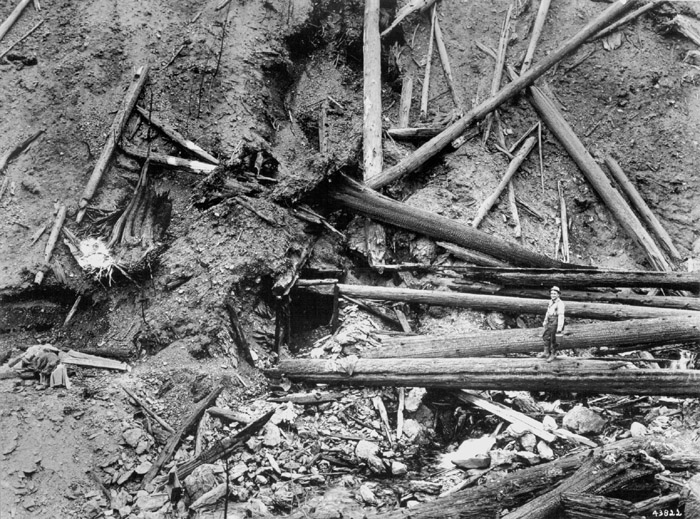
W.W. Morris stands on a charred tree trunk near the mouth of the tunnel where Ranger Edward Pulaski sheltered with his men during the Big Blowup. All but five of the men survived (photo ca. September 1910).
Ranger Ed Pulaski’s heroism that day quickly became legend. Fighting a fire about 10 miles southwest of Wallace, Pulaski ordered his crew of 43 men to follow him to a mineshaft. One man was too slow and died in the flames. The rest barely outran the fire. Pulaski hung blankets over the entrance and ordered his men to lie down on the tunnel floor, threatening to shoot anyone who tried to flee. Using water from a small stream that flowed out of the tunnel, Pulaski kept the blankets wet with hatfuls of water until he was overcome by the smoke. When the men awoke the next day, all but five had survived. Of the survivors, Pulaski suffered more than most. He was temporarily blinded by the ordeal, and his lungs were so damaged that he could barely breathe.
Newspapers across the country quickly spread the story of Pulaski’s courageous actions, elevating him to mythic stature in Forest Service history. He added another chapter to his legend when he invented the firefighting tool that bears his name by combining an axe and a mattock in one tool that has been standard issue for wildland firefighters for decades. Pulaski was never compensated for wounds received during the firestorm nor for his invention, but in 1923 he wrote an account of his actions in the Big Blowup for an essay contest because he needed money to pay for eye surgery. He won $500.
Even before the fires burned themselves out, the Forest Service was actively defending its reputation and justifying its policy of extinguishing all fires as quickly as possible. Those who fought and survived the fire knew they had been thoroughly defeated by the forces of Nature. After the flames had ripped through the Bitterroot Mountains, Lolo National Forest Supervisor Elers Koch considered the 1910 firefighting efforts to be a “complete failure” that saw the Forest Service expend almost a million dollars over budget.
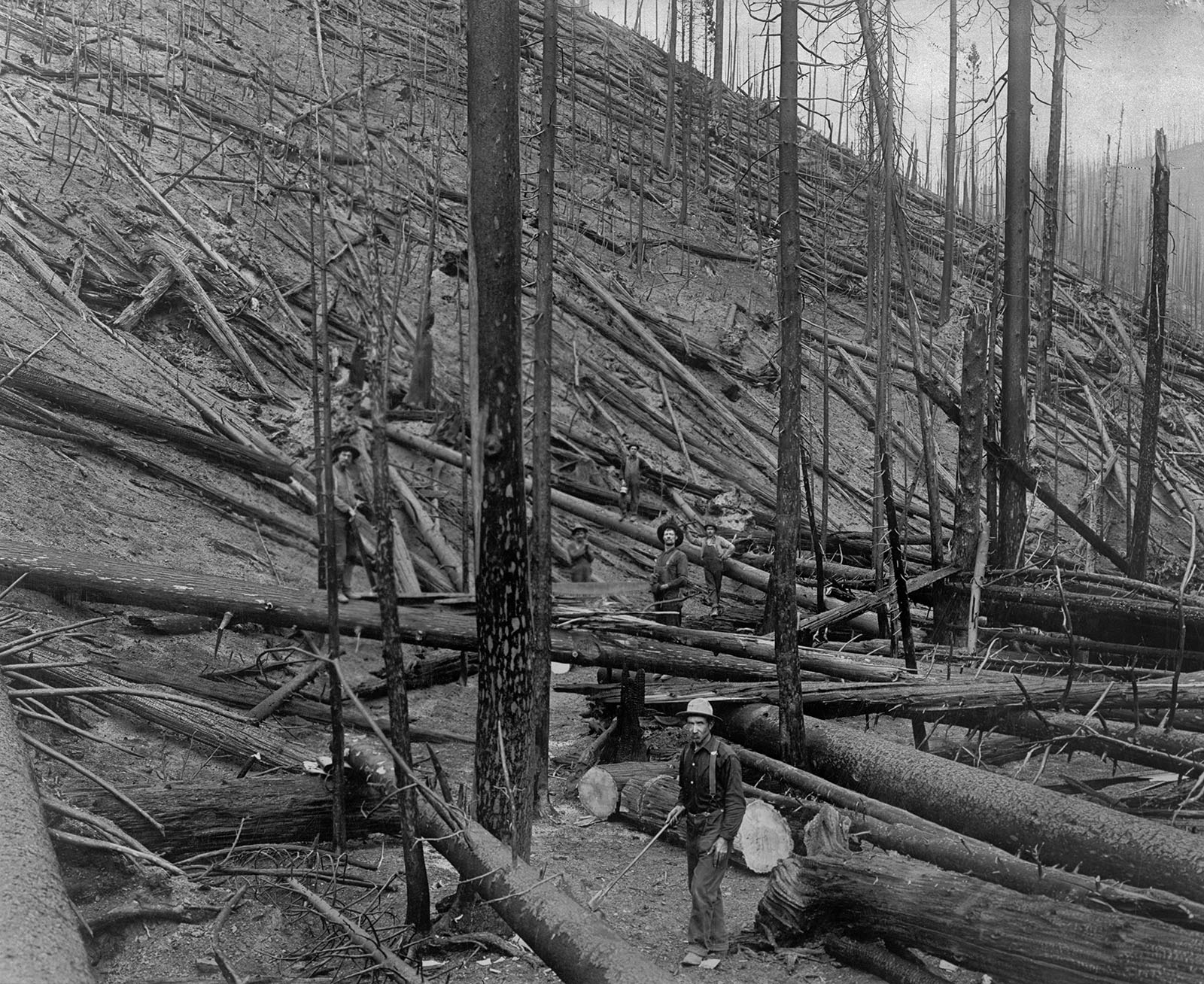
Workers stand amid the charred remains of a white pine grove following a wildfire “hurricane” that occurred during the Big Blowup on the Little North Fork of the St. Joe River near Coeur d’Alene, Idaho.
But several foresters, including Forest Service Chief Henry Graves, called for an aggressive fire prevention policy to protect the nation’s forests and economic well-being. Ferdinand Silcox headed the region’s quartermaster corps during the fire and later served as Forest Service chief in the 1930s. He argued that fire should be eliminated from the landscape. He believed that applying science, technology, and manpower would solve the problem and prevent future disasters. Others pointed to heroic efforts by the Forest Service during the disaster as evidence that the agency needed more funding to meet the demands of its mission. (In retrospect, these early efforts to defend and promote the Forest Service likely distorted the historical record, understating the contributions of those conscripted to fight the fires, including 4,000 soldiers who served in roles they were not trained for.)
Not everyone agreed with these assessments. Koch argued in favor of letting backcountry fires burn themselves out. After part of the newly created Glacier National Park burned, Secretary of the Interior Richard Ballinger supported annual burning to reduce fuel loads, a common practice among indigenous peoples at the time. But Forest Service leadership and forestry leaders like Gifford Pinchot spent years suppressing and discrediting alternative viewpoints from people like Ballinger.
Chief Graves staked the agency’s continued existence on the belief that it could actually defeat fire. To strengthen his hand, Graves adopted a collaborative approach with state and private associations to fight fire. His efforts were rewarded and given the weight of law with passage of the Weeks Act in 1911. Graves then embarked on a campaign to remove all fire from the landscape. His campaign lasted for decades and led to the creation of Smokey Bear in 1944. Thanks to the Weeks Act, state forestry agencies became beholden to the U.S. Forest Service, supporting its fire-suppression policies to receive federal funding.
An ally of Graves, William Greeley, had been hand-picked by Chief Pinchot to be the Forest Service Region 1 forester overseeing 41 million acres in 22 national forests, mainly in Montana, Idaho and Washington. Greeley was the son of a Congregational minister, and in 1920, he became Forest Service chief. Convinced that the Big Blowup was the result of Satan’s work, Greeley, driven by religious fervor, made fire suppression a focus of the agency, fundamentally changing forest ecology across the country. Other nations adopted the U.S. fire suppression model, part of the legacy of the Big Blowup.
Greeley and his next two successors, Robert Stuart and Ferdinand Augustus Silcox, were all personally involved in the Big Blowup. Silcox concluded the lesson was that fires were wholly preventable by deploying more money, more men, more trails, and a stronger will. In 1934, the Selway fires sparked a review of Forest Service fire policies. The agency admitted that, in spite of increased funding, the lands it managed were in worse shape than when responsibility for those lands was taken from the Interior Department and shifted to the Forest Service in the Ag Department. In the wake of the review, Chief Silcox faced critics who observed that the Forest Service was unable to contain backcountry burning and scientists who demonstrated that fire was beneficial to certain tree species.
One critic, Ed Komarek, noted that such facts had been shielded from the public view. Lolo National Forest Supervisor Elers Koch asserted that the pursuit of fire into the backcountry, especially road-building, was undermining the cultural value of those lands. Lolo Pass, a key point on Lewis and Clark’s journey through the Bitterroot Mountains, had been bulldozed into a highway, he complained. In response to these critics and criticisms, Silcox doubled down, announcing the 10 a.m. Policy, a decades-defining edict that established a nationwide goal of controlling every wildfire by 10 a.m. the next morning.
Driven by policies justified by the Big Blowup, “by the 1990s, the American fire establishment was a wonder of the world,” Pyne writes. “It could field crews and aircraft to fight fire in numbers larger than the military of some Third World nations.” Yet critics inside and outside the fire-industrial complex realized that the system was broken, based in part on increasingly large fires. Wildfires burned over 4 million acres in 1994, costing $965 million above budget allocations and killing 34 firefighters.
Wildfires consumed more than 6 million acres and $1.6 billion in 1996. Forest Service firefighters had successfully contained 98% of wildfires before they grew larger than 100 acres, a success rate they continue to maintain, yet the costs of fire suppression and wildfire destruction have continued to escalate. Forest Service officials finally admitted that firefighting alone could not contain wildfire and shifted attention to wildfire mitigation, but the admission came in the aftermath of court rulings that forced the Forest Service to greatly restrict old-growth clear-cutting, which had already fueled an increase in catastrophic wildfire and a decline in forest health.
In 2006, wildfires burned 9.8 million acres. In each of the years 2015, 2017, and 2020, more than 10 million acres burned. Even after the admission that a century of fire-suppression policy had failed, three decades of logging under the guise of fire mitigation have only seen uncontrollable wildfires increase in size and severity.
Once again, federal leadership is doubling down on a flawed agenda that will increase logging and wildfire mitigation activities that have proven to be detrimental. According to Redefining the Urban Wildfire Problem in the West, published in 2024, the current paradigm is fundamentally “inconsistent” with the scientific consensus that fire is “a sustaining ecological factor in fire-adapted ecosystems.”
The report was co-authored by six experts, including Stephen Pyne and three Forest Service researchers, Jack Cohen, Mark Finney, and David Calkin. Given the necessity of fire for ecosystem health, the authors call for acknowledgment that wildland fire is “ecologically appropriate and inevitable.” As difficult as it may be to accept, the solution to the wildfire problem, they write, requires “much more fire and increased short-term risk.”
To reduce wildfire risk at the scale needed to protect communities, the authors recommend planning and regulatory actions, including updated building codes that incorporate Firewise design. The report exposes the gap between expertise of Forest Service scientists and funding priorities of politicians and bureaucrats — priorities that continue to promote policies with a century-long track record of failure.
Featured Image:Workers stand amid the charred remains of a white pine grove following a wildfire “hurricane” that occurred during the Big Blowup on the Little North Fork of the St. Joe River near Coeur d’Alene, Idaho.