In 1995, I started working for the Forest Service as a GS-4 wilderness and trails crew leader in the Chiricahua Mountains of southeast Arizona. The year before, the Rattlesnake Fire had torched the Chiricahuas with an intensity that vaporized three feet of pine-needle duff and killed old-growth trees that had survived fire before. I was told nothing would grow in that moonscape for 50 years because the soil had been sterilized.
As we cleared burnt, fallen trees from the trails, I noticed beetles burrowing into the blackened logs. Then came the woodpeckers, eating the bugs that were eating the dead trees. Flowers and grasses flourished in the new sunlight, drawing bees, birds, rabbits, and deer. Mountain lion tracks appeared on our rebuilt trails.
Most amazing were the aspens. Roots that had fed big trees survived deep underground and now fed saplings, some of which topped 8 feet in their first year. The people who told me nothing would grow were wrong, and that wasn’t all the agency got wrong.
Fire crews had seeded the burn with sterile hemp grass to stabilize the slopes. The first heavy rains flushed the seed into the creeks below, where it sprouted and lured cattle into sensitive riparian areas. Meanwhile, there was no money to reseed the fire camp, which had been hammered by hundreds of firefighters and their tents and trucks. It recovered on its own within a year.
That experience taught me that we underestimate nature and overestimate ourselves. Today that hubris has a name: “active management.”
Across the Southwest, in the name of wildfire risk mitigation, the Forest Service has been chaining old-growth piñon-juniper forests, dragging trees down with chains and then shredding them with large machines to widen the gaps between trees. This does reduce the risk of crown fire. But the machinery breaks up the fragile biotic soil crust that nurtures native grasses and shrubs. Cheatgrass and other invasive plants move in. Without shade and windbreaks, the soil dries out.
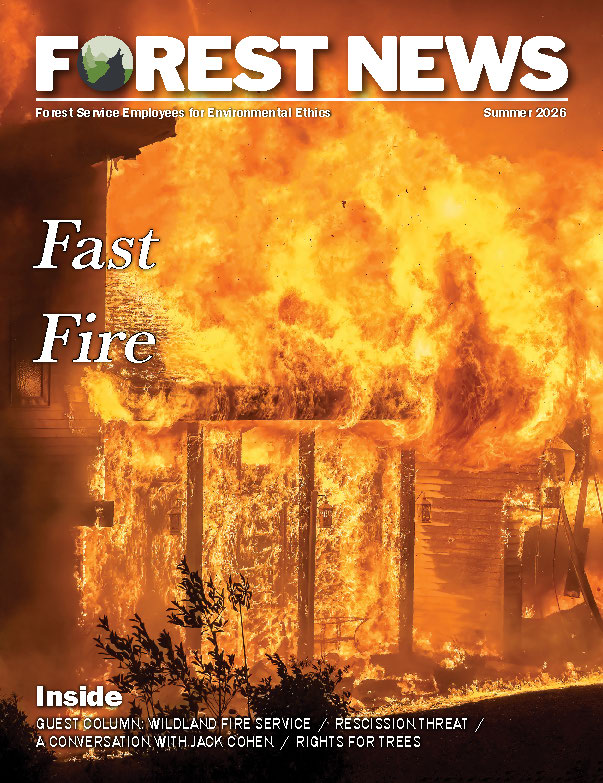
The Forest Service counts these as acres successfully treated. What we actually have is a drier, windier forest carpeted with flammable, invasive weeds. Researchers have shown that the most destructive fast fires spread through burning grasslands, and that soil aridity is a critical indicator of fire spread potential.
In California, the agency administered a timber sale that clearcut the forest near a mountain community. Two years later, resinous, flammable Scotch broom filled the opening. The agency invoked its wildfire emergency authority, and its employees sprayed the herbicide glyphosate. Locals no longer go there to walk their dogs or gather mushrooms and berries. That emergency is not rare. The Secretary of Agriculture has declared 59 percent of all national forest lands an emergency situation, where the Forest Service can act with almost no environmental review or public engagement. When most of the system is in an “emergency,” the word loses its true meaning and instead comes to mean “business as usual”: degradation and disenfranchisement.
The most glaring active management folly concerns fire itself. “Every unplanned ignition on National Forest System lands is managed under a full suppression strategy,” the Forest Service chief wrote this spring. The same letter concedes that fire is “a natural and necessary part of our landscapes.” The agency admits fire belongs on the land and suppresses every ignition anyway. That policy is failing, damaging, expensive, and dangerous to firefighters.
We must manage our national forests better. The more we blend our management practices with natural agency, the more ecological, economic, and practical sense they will make. The answer to fire exclusion is fire inclusion — prescribed fire and managed fire — because fire is coming anyway. We should measure success in acres burned rather than acres treated. We should assume flammable invasive weeds will follow every new road and machine and weigh that consequence honestly against the purported benefits. We should use goats rather than poison to treat those weeds. We should remove concrete dams and bring back beavers to build willow ones. With more than 368,000 miles of Forest Service roads, we should stop building new ones and remove the ones we cannot maintain.
The agency is headed the in the opposite direction. Its strategy directs a nationwide review of forest plans “to identify and remove obstacles to timber harvest.” Those obstacles are the lawful protections for water, wildlife, and old-growth trees that the public helped write into those plans.
At Forest Service Employees for Environmental Ethics, our mission is to protect national forests and promote environmental ethics. An ethic begins with humility. In the words of renowned ecologist — and former Forest Service employee — Aldo Leopold, “A thing is right when it tends to preserve the integrity, stability, and beauty of the biotic community. It is wrong when it tends otherwise.”
The national forests are a shared trust, not a woodlot, and the forest is not an obstacle to its own management. In the Chiricahuas, nature flourished regardless of our ignorance. Roadless areas, intact habitat and healthy watersheds provide greater values whole than carved up to extract single resources. Here at FSEEE, we will continue to use education, advocacy, and the law to impress upon the Forest Service that our public lands will do better with less human hubris and more natural agency.